
RCXS
Commentary report
Oct-Mar 2025/26
Over 100,000 people have taken part in the Rail Customer Experience Survey (RCXS)
Our report makes sense of this huge dataset – and considers it alongside the recently updated What Matters to Passengers research – to set out what we believe should be the customer priorities for improving the railway.
This is the first of our regular reports on the RCXS, which we will use to represent the interests of passengers as the passenger watchdog. In the coming months, we will have enough data to say whether customer experience is improving. The RCXS six-month report is an Official Statistic (in development). The survey’s power will only grow in future years, as trends can be tracked and the impact of changes evaluated.
We want the passenger voice to be heard at every step – so that Britain’s railways consistently deliver excellent services. That means we will be:
- Independently monitoring passenger experience, supplementing RCXS data with other evidence.
- Transparently reporting on what we find.
- Holding the industry, including senior leaders, to account.
The rail industry also needs to use the RCXS: operators can interrogate their data to deal with local issues, while at a national level it can be used to inform priorities and set policies that focus on pain points for passengers. Some operators have their own market research but there is now a ‘single source of truth’ about the passenger experience rather than a patchwork of different, not necessarily comparable surveys.
There is already considerable focus across the industry on punctuality and reliability, which we know is the highest priority for passengers. Our research has led us to prioritise three issues for additional attention: management of disruption, accessibility and personal security.
While the RCXS data mainly relates to how people experience specific journeys, it also includes broader questions about how they feel about the railway and if they would recommend it to other people. The scores on trust are striking. 45 per cent of surveyed passengers do not trust the railway despite using it1. This is a major challenge and one that cannot be addressed overnight. It points to the need for a credible, long-term customer strategy that builds confidence in the railway. Showing that the issues identified in this report are being addressed can only help.
Future reports will examine other issues that are important to passengers as the survey progresses and analysis yields fresh insights.
Key findings
Headline performance
87 per cent of passengers are satisfied with their journey on Britain’s railways with a 16 percentage point gap between the highest and lowest operator scores.
The number one priority for passengers is trains running on time and not being cancelled2 – 86.4 per cent of station stops are arrived at within three minutes of their scheduled arrival time and 3.2 per cent of trains are cancelled3.
Disruption – and how it is handled – has a fundamental impact on how passengers describe their journey.
- Nine in 10 passengers who are not delayed are satisfied with their journey.
- Fewer than three in 10 people who are both delayed and dissatisfied with the handling of that delay are satisfied with their journey overall. If they are satisfied with the delay handling nine in 10 are satisfied with their journey overall.
Accessibility is a major test for how rail reform will be judged. Disabled people have told us in other research that the barriers they face can prevent them from using the railway.
- Disabled people are less satisfied with station toilets, ease of moving around the station and seats on trains.
- Six in 10 who said they – or the person they were travelling with – had assisted travel needs and asked for assistance – received all the assistance they needed. One in 10 said they received none of it.
Personal security on the train and at stations are now in the top five issues in our What Matters to Passengers research. The RCXS sheds new light on this issue.
- Four in five people are satisfied with personal safety at the station and on the train – three per cent are dissatisfied. This leaves a middle ground of people who are neither satisfied nor dissatisfied.
- It may be that people are simply not travelling if they are concerned for their personal security4.
Our recommendations
To make progress across these priorities we are asking the leadership of the railway across Great Britain to work with us to:
- Develop and share a customer strategy and plan for the railway.
- Consult us during the transition to Great British Railways on any changes that may impact on customers.
- Set out how Great British Railways will be accountable to its passengers.
Britain’s railways can get a lot better. The RCXS will help us hold operators to account and make that a reality.
Contents
Chapter
01
Key performance statistics from across the rail industry
Chapter
02
A major impact on how passengers describe their journey
Chapter
03
Disabled passengers have a worse rail experience
Chapter
04
A growing concern for rail users
Chapter 01
Headline performance
From buying a ticket to feeling safe on the train, passengers care about their experience on Britain’s railways. Headline performance data offers an industry ‘pulse-check’ on the issues that mean the most to passengers.
of passengers are satisfied with their journey on Britain’s railways.
of station stops are arrived at within three minutes.
of trains are cancelled5.
These overall figures represent many individual journeys and experiences. With at least 10,000 responses every four weeks, the RCXS has the statistical power to show the impact of delay and how satisfaction varies between different groups of travellers.
The longer the delay experienced, the lower the overall journey satisfaction
- Overall satisfaction
- Satisfaction with entire journey: 87%
- No delay
- Satisfaction with entire journey: 92%
- Under five minutes
- Satisfaction with entire journey: 83%
- 5-14 minutes
- Satisfaction with entire journey: 69%
- 15-29 minutes
- Satisfaction with entire journey: 54%
- Over 30 minutes
- Satisfaction with entire journey: 40%
The experiences of different passengers
Overall satisfaction is highest in Scotland and lowest in England
When it comes to passenger satisfaction, the best performing part of the railway in Great Britain is Scotland on 91 per cent, just ahead of Wales on 89 per cent and England on 87 per cent.
Source: Transport Focus - Rail Customer Experience Survey Oct-Mar 2025/26. Question: Overall, how satisfied or dissatisfied were you with your entire train journey from origin to destination?
Our train operator rankings show that performance and ratings for value for money in the RCXS are not uniform across the network.
Satisfaction overall – train operator results
There is a 16 percentage point gap from the highest to the lowest rated operator for overall satisfaction.
| Train operating company | Satisfied | Neither/nor | Dissatisfied |
|---|---|---|---|
| Greater Anglia | 88% | 8% | 3% |
| Great Western Railway | 86% | 8% | 6% |
| South Western Railway | 85% | 10% | 5% |
| Thameslink | 83% | 11% | 6% |
| Southeastern | 87% | 9% | 4% |
| London Northwestern Railway | 85% | 11% | 4% |
| London Overground | 89% | 8% | 3% |
| Chiltern Railways | 83% | 11% | 6% |
| C2C | 85% | 11% | 4% |
| Elizabeth Line | 90% | 7% | 3% |
| Gatwick Express | 89% | 8% | 2% |
| Heathrow Express | 92% | 6% | 2% |
| Southern | 86% | 10% | 4% |
| Stansted Express | 90% | 7% | 3% |
| Great Northern | 86% | 9% | 5% |
| London & South East | 87% | 9% | 4% |
| TransPennine Express | 87% | 8% | 5% |
| Avanti West Coast | 86% | 8% | 6% |
| LNER | 93% | 5% | 2% |
| Lumo | 90% | 6% | 4% |
| Hull Trains | 94% | 4% | 2% |
| CrossCountry | 79% | 12% | 10% |
| East Midlands Railway | 82% | 10% | 8% |
| Grand Central | 87% | 8% | 4% |
| Long Distance | 85% | 9% | 6% |
| Northern | 87% | 8% | 5% |
| Merseyrail | 92% | 5% | 3% |
| Transport for Wales | 90% | 7% | 3% |
| West Midlands Railway | 87% | 9% | 4% |
| ScotRail | 92% | 6% | 2% |
| Regional | 89% | 7% | 4% |
| Total | 87% | 9% | 4% |
Satisfaction with value for money – train operator results
There is a 26 percentage point gap from the highest to the lowest rated operator for value for money.
| Train operating company | Satisfied | Neither/nor | Dissatisfied |
|---|---|---|---|
| Greater Anglia | 54% | 17% | 29% |
| Great Western Railway | 53% | 17% | 31% |
| Northern | 65% | 14% | 20% |
| South Western Railway | 52% | 20% | 28% |
| Thameslink | 52% | 19% | 30% |
| TransPennine Express | 65% | 14% | 21% |
| Avanti West Coast | 50% | 18% | 32% |
| Southeastern | 53% | 19% | 28% |
| Merseyrail | 70% | 14% | 17% |
| Transport for Wales | 70% | 14% | 16% |
| LNER | 61% | 17% | 22% |
| London Northwestern Railway | 58% | 18% | 24% |
| West Midlands Railway | 63% | 18% | 19% |
| London Overground | 66% | 18% | 16% |
| Lumo | 75% | 13% | 12% |
| Hull Trains | 73% | 12% | 15% |
| ScotRail | 70% | 13% | 16% |
| Chiltern Railways | 53% | 17% | 31% |
| C2C | 57% | 19% | 25% |
| CrossCountry | 55% | 16% | 29% |
| East Midlands Railway | 55% | 15% | 29% |
| Elizabeth Line | 65% | 17% | 18% |
| Gatwick Express | 50% | 17% | 33% |
| Grand Central | 68% | 13% | 18% |
| Heathrow Express | 68% | 16% | 16% |
| Southern | 55% | 19% | 26% |
| Stansted Express | 56% | 20% | 24% |
| Great Northern | 49% | 20% | 31% |
| London & South East | 57% | 18% | 24% |
| Long Distance | 57% | 16% | 27% |
| Regional | 68% | 14% | 18% |
| Total | 59% | 17% | 24% |
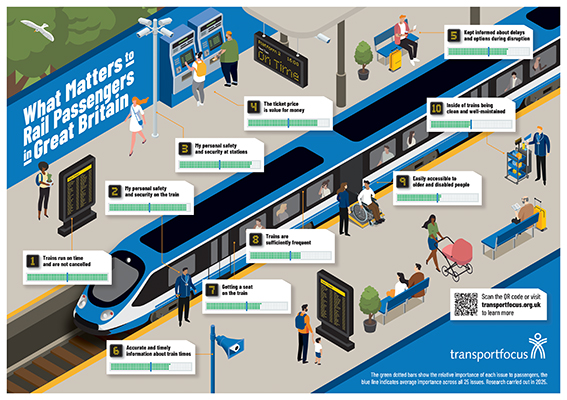
What Matters to Passengers
Rail operators need to be guided by passenger priorities. Our recently released What Matters to Passengers listened to the experiences of thousands of people to understand what they want from the railway.
Rail operators need to be guided by passenger priorities. Our recently released What Matters to Passengers listened to the experiences of thousands of people to understand what they want from the railway.
Our next steps
The railway is committed to reducing its net subsidy. But financial pressures on the railway do not remove the need – or potential – to improve passenger experience. With the growing proportion of journeys for leisure and competition from other modes and video calls, the railway will not grow demand if the user experience is not good enough.
This report is not a one-off publication, but the start of an ongoing accountability cycle. To demonstrate progress in future results of the surveys, it is essential that the rail industry:
- Maintains focus on core service delivery during a period of industry change.
- Addresses the issues that matter most to passengers.
Accountability and escalation
The new passenger watchdog will respond to poor performance with an evidence-led approach about what drives improvement for passengers – our emphasis is on transparency, learning and engagement.
The three questions we will consistently be asking are:
- Does the operator have the right priorities? We expect operators to prioritise the things that matters most to their passengers as part of a customer focussed culture. We will always expect the needs of disabled passengers to be prioritised.
- Are there credible plans in place to address passenger priorities? We recognise that change can take time and that a range of factors will affect how quickly operators are able to make improvements. Passengers will accept this if there is a credible plan for improvement.
- Is progress being made in line with those plans? The RCXS and other feedback directly from passengers allows us to track progress. Plans will sometimes be delayed or be delivered as planned but not have their intended impact on passengers.
We will do this by:
- Identifying issues through feedback from passengers, survey data and analysis.
- Engaging directly with operators to understand causes and improvement plans.
- Publicly reporting progress and best practice while highlighting poor performance where necessary.
- Escalating concerns where appropriate.
CrossCountry
CrossCountry is the operator with the lowest overall satisfaction, with low satisfaction scores for punctuality, crowding and the overall train experience. Cancellations remain high6.
The leadership of CrossCountry face tough challenges with capacity and service consistency. Neither of these are likely to be resolved swiftly. There are also further pain points for customers on issues such as cleanliness and delay handling where progress can be made more quickly.
- We have highlighted to CrossCountry the problems that passengers are facing.
- They are aware of the challenges and are already taking action with refurbished trains and wider plans for improvement.
- As the passenger watchdog, we will continue to track progress and advocate for passengers who are not receiving an adequate service.
“The trains are always overcrowded with people standing and insufficient room to store luggage. The trains are old and seats not very comfortable if you are lucky enough to get one! … This poor service does not justify the high price of tickets … I dread the journey on these overcrowded and poorly serviced trains.”
Next steps for the railway
The industry is going through a significant period of change. We recognise the challenges this creates, but that doesn’t mean that improvements for passengers should be delayed and it is clear from our engagement with senior leaders in the railway that this is widely recognised.
All operators should engage with the issues in this report and the Rail Customer Experience Survey data. We will support them as they do this by sharing good practice and bringing people together where it would help. There are specific recommendations in the priority areas we have highlighted.
We will also be asking the leadership of the railway in all parts of Great Britain to work with us to do three things:
- Develop and share a customer strategy and plan for the reformed railway. This should prioritise creating a passenger focussed culture that engages colleagues at every level and has the credibility to build trust amongst the travelling public. We would expect it to address the passenger priorities in this report and learn from other organisations that have been successful in developing a customer focussed culture.
- Consult us on the decisions, policies and plans that will impact passengers over next 18-24 months during the transition to Great British Railways. For us to do this effectively we need early sight of decisions that may impact customers and sufficient time and information to test any unintended consequences.
- Set out how Great British Railways will be accountable to its passengers once established. For us and others to hold GBR to account effectively it will be important for it to operate transparently and there to be clarity about who is responsible for making decisions that affect passengers at a national, route and local level.
Chapter 02
Disruption
No one likes being delayed. But the RCXS finds that when passengers think their delay has been badly handled their satisfaction plunges. Getting better at managing and communicating delay is essential to raising customer satisfaction.
- Overall satisfaction falls when passengers are delayed
- Delayed: 68%
- Not delayed: 92%
- But how delays are handled, dramatically impacts overall satisfaction
- Handled poorly: 26%
- Handled well: 92%
“The delay was well announced and there was nothing the driver could have done to improve the situation. The announcements were very welcome.”
Overall, 48 per cent of people were satisfied with how their delay was handled.
- People with longer delays and commuters are generally less satisfied.
- There is some variation within Great Britain with 48 per cent in England, 54 per cent in Wales, 58 per cent in Scotland.
- There is wide variation between train operators, with a 28 percentage point gap between the highest and lowest rated operator.
Half of people were satisfied with how long it took to deal with the delay, how often information was provided and how useful and accurate it was.
- 40 per cent are satisfied with how clearly the reason for the delay was explained.
- 37 per cent were satisfied with the information provided about alternative routes, onward travel or connections as a result of the delay. There is a 24 percentage point gap between the highest and lowest operators.
“I was very disappointed with the communication received as it was very conflicting and inflicted more personal stress. Due to this, I was late for work in the NHS.”
What passengers need
Improving the passenger experience during disruption is a priority for Transport Focus. As well as carrying out research to better understand what passengers think, we have worked on the ground with operators – watching how things work in control and customer service centres.
At the same time, we monitored the passenger experience so we could see the industry and passenger perspectives together. Our report, Improving passenger experience when trains are disrupted, sets out three key areas: think passenger, improve information and keep people moving.
- Better information
The railway should substantially improve the quality of information during unplanned disruption. Particular focus is needed on providing clear, concise and useful information that helps passengers make an informed choice about what they do when there is a problem. That includes information on websites, apps, station screens and available for staff to pass on to passengers. It will need investment in people and systems.
- Think passenger
When anything goes wrong on the railway there are two valid and potentially competing objectives: getting the service back to normal and looking after the interests of passengers inconvenienced in the meantime. The industry should constantly strive to maintain a culture that seeks the right balance between the two, never forgetting about those already caught up in a problem while it’s being fixed.
- Keep people moving
When there is disruption, the railway should act decisively to keep people moving to where they want to go. It will mean challenging the idea that action isn’t needed until a delay reaches 60 minutes, even when alternatives could have been offered so people get to their destination on time.
This may mean offering alternative transport sooner than now. But it will build confidence that the railway will do its utmost to minimise the impact on passengers when something goes wrong. In short, that people can trust it as a reliable way to travel.
Recommendations
The rail industry continues efforts to improve disruption handling, with initiatives such as ticket acceptance between DfT-owned train companies during disruption, Brilliant Basics approach and outputs from the Smarter Information, Smarter Journeys programme. But there is more to do, as illustrated by the RCXS results, and later this year we will bring together senior industry leaders at a summit to discuss progress.
Better delay handling is one of the major opportunities to improve satisfaction. Our report Improving passenger experience when trains are disrupted, can be used to ‘think passenger’ when delays occur. We recommend three priorities for action to make a difference for passengers, with train operators, Network Rail and governments all having parts to play:
- Substantial improvements in the quality and consistency of information during unplanned disruption – with a particular focus on the written language skills needed to craft and share clear, concise and useful information in the minimum time possible.
- During disruption, it needs to be clear to passengers what they should do in light of the problem – whether the disruption is the cancellation of a single train – up to a total suspension of service.
- Roll out of On-Train Passenger Announcements with priority given to driver only operated services so that passengers can hear directly from the control room.
Chapter 03
Accessibility
Disabled passengers are slightly less satisfied with their overall experience of a journey than people who are not disabled7. The three percentage point gap – 85 per cent versus 88 per cent for non-disabled people masks wider variation in some key areas related to accessibility.
Disabled passengers experience lower satisfaction in key station facilities
Station infrastructure remains a real barrier with known problems - difficult to use ticket machines or lift problems going unsolved for long periods. Onboard, disabled customers also have a worse experience of storage spaces, seat comfort and cleanliness. Both off and on the train, there is worse satisfaction with personal safety for disabled people.
- Toilets
- Disabled: 73%
- Non-disabled: 80%
- Seating
- Disabled: 75%
- Non-disabled: 81%
- Ease of moving around
- Disabled: 82%
- Non-disabled: 87%
There is also evidence that accessibility issues are not just leading to lower satisfaction with a given journey, but reducing the travel options for disabled people. In our What Matters to Passengers research8, 37 per cent of disabled passengers told us they would use trains more in the future if accessibility improvements were made.
Raising the satisfaction of disabled people to those without disabilities must be a core priority for the rail industry. A more accessible railway would be likely to have more customers and would also give disabled people more access to jobs, leisure and social opportunities. This is desperately needed – the economic inactivity rate of disabled people is three times that of non-disabled people9. Disabled people are also much more likely to be chronically lonely10.
“I arranged passenger assistance – but none was forthcoming [which] caused me pain and discomfort all through the journey.”
Causes of lower satisfaction among disabled passengers
Large satisfaction gaps are not seen in all parts of the survey.
Disabled people are particularly likely to need assistance. Our survey asked those with assisted travel needs – or travelling with someone with those needs – about their experience. Only seven in 10 said they – or the person they were travelling with – received all the assistance they needed11. One in 10 said they received none of it. When assistance works, it can be highly valued.
“Booked passenger assist and a lovely member of staff … helped me and the person I am a carer for, he was very professional and considerate and helped us immensely.”
Storage for mobility aids
Three in four people with a mobility aid said there was space for it on board the train. The survey asks whether a passenger had to wait for another train because there was no space for their mobility aid on the one they intended to catch. However, it can be a trying experience:
- For 15 per cent, items or people had to be moved/move for them – this figure is 34 per cent if their train was delayed.
- Six per cent had to use space in an aisle or standing area – on delayed trains this doubled to 12 per cent.
Passenger Assistance
Satisfaction with passenger assistance, where it is received is 87 per cent. This includes everyone who asks for assistance, not just those who booked Passenger Assist. This accounts for less than one in 10 of the people who said they needed assistance for themselves or someone they were travelling with.
The Office of Rail and Road surveyed people who had booked Passenger Assist and found a broadly similar proportion of passengers were satisfied with the assistance they had delivered to them. The service remains inconsistent with 11 per cent reporting that they received none of the assistance that they booked12.
“Have been left on train several times by guards that have forgotten I was on there. It’s a very stressful experience.”
Recommendations
Bringing the satisfaction of disabled passengers up to the level of those who are not disabled will not happen quickly, but it is a core part of our mission as the passenger watchdog.
The Accessible Travel Framework in Scotland, Travel for All in Wales and the Accessibility Roadmap in England is an important starting point in a period of transition for the railways and should be delivered in full, in partnership with disabled people. It needs to go alongside a long-term strategy for making the railway accessible. The findings of the RCXS underline the need for improvement in its priority areas of:
- Accessibility of stations and trains.
- Reliability of key accessibility facilities.
- Consistency and reliability of both booked Passenger Assist and help for people who want to ‘Turn Up and Go’.
Delivering this needs a culture change in the industry:
- All senior colleagues in the railway should regularly spend time with disabled passengers travelling on the network to see for themselves the difficulties they encounter.
- All operators should proactively seek complaints and other feedback to identify where they are consistently failing disabled passengers.
Chapter 04
Personal security
Personal security on the train and at stations are now top five issues in our What Matters to Passengers research. The RCXS shows satisfaction about particular journeys. Our analysis of the new data adds to existing insight on this important issue and finds a variety of issues rather than one simple explanation.
are satisfied with personal safety at the station.
are neither satisfied nor dissatisfied.
are dissatisfied.
Travellers in Scotland (88 per cent) were somewhat more satisfied than those in Wales (84 per cent) and England (83 per cent). There is variation between operators with a 16 percentage point gap between satisfaction with personal safety on the train between the highest and lowest scores.
Satisfaction with personal safety is marginally better on the train
- At the station
- Very satisfied 47%, Fairly satisfied 36%, Neither/nor 14%, Very/fairly dissatisfied 3%
- On the train
- Very satisfied 50%, Fairly satisfied 36%, Neither/nor 12%, Very/fairly dissatisfied 3%
“As a single female this is not a safe viable option for me because… the station is unmanned, not well lit and in the middle of nowhere.”
Satisfaction with personal safety at the station by demographic group
Satisfaction with personal security is a bit higher amongst passengers from White and Black ethnic backgrounds. Asian and mixed ethnic groups are less likely to describe themselves as very satisfied13.
Other questions where our analysis found meaningful results were:
- Satisfaction is highest at stations with 0.5 – 2million trips per year (‘important feeder stations’, such as Plymouth or Tamworth) and lowest at small unstaffed stations (six percentage point gap).
- Passengers starting their journey after 4pm are less satisfied than those starting before then, in other research passengers report feeling less safe after dark14: (four percentage point gap).
“With rowdy passengers (playing loud music, heavy drinking even in front of children etc) I did not feel fully safe for myself, or my family on this train.”
Interpreting the results
Our recently published What Matters to Passengers research had ‘my personal safety and security on the train’ as the second highest priority for passengers and ‘my personal safety and security at stations’ as third highest. In 2022, these were sixth and eighth respectively.
This is part of a wider trend, the proportion of people saying crime was an important issue facing the UK has risen from 49 per cent in November 2022 to 56 per cent in March 202615.
Other research with passengers finds that travelling after dark, staff visibility and anti-social behaviour are key issues. There are also important differences by gender16. Further work is needed to understand the nuances between the high priority that passengers give personal safety in general but low levels of dissatisfaction with any given journey.
Possible reasons include:
- Passengers are only surveyed up to 10pm so some passengers travelling later are not part of the survey.
- It is possible the presence of an interviewer could make somebody feel safer.
- The survey reaches those who are travelling – people may simply not travel on the train if they are concerned for their personal safety. Research we published in 2024 found that 9 per cent of non-users did not use local trains due to concerns about other passengers’ poor behaviour17.
Summarising the lessons of the data
The survey adds to the picture of what is driving concern about personal safety and where targeted improvements could make the greatest difference:
- Perceived safety is associated with multiple factors such as time of day, the station environment, and how frequently people travel.
- Some passenger groups such as those caring for adults and young people are less satisfied.
- Qualitative research from What Matters to Passengers shows how antisocial behaviour undermines people’s feelings of safety.
“I feel very safe on the train even when I am travelling alone.”
Recommendations
The industry already has significant evidence about passenger safety concerns – it now needs to develop a collective strategy to manage the railway’s public realm so that it is both safe – and feels that way – for more passengers. While these issues may not be the industry’s fault – they matter to its passengers and so are its problem.
Improving satisfaction with personal safety will come about only through the actions of a wide range of partners.
- DfT Operator should ensure that all areas have the structures and working practices in place so that police, security staff and the wider staff group can share intelligence, understand hot spots and respond when needed. This can build on some existing good practice.
- A central body needs to take responsibility for leading a programme of evaluating security interventions that can be rolled out at scale. For example, frontline staff are increasingly using body-worn cameras but we need to understand whether this technology reduces incidents.
Methodology
The RCXS is the biggest passenger satisfaction survey in the history of Britain’s railway. With a minimum sample size of 130,000 passengers a year, it has the statistical power to give granular insight into a wide range of experiences.
About the survey
- Respondents are recruited face-to-face on board the train – unless the sampled service isn’t running.
- Passengers have the option to complete the survey online on their own device or can request a phone call to complete the survey over the phone (which replaced the option to complete a paper questionnaire in March 2026).
- Unlike the previous National Rail Passenger Survey, RCXS runs throughout the year, with results available every rail period (28 days).
It can be analysed to show the experiences of different parts of the population with greater granularity than before – whether by demographic group or departure station in different regions and between England, Scotland and Wales.
Interpreting the results
Data collection started in July 2025 and has already provided important insight – such as the scorecards for each operator that we launched in December 2024. This report draws on our official statistics publication as well as our own analysis. This goes alongside research such as our What Matters to Passengers publication, which enables us to rank the importance of different aspects of rail services. RCXS headline results are rounded to the nearest whole number, whereas operator comparisons use figures rounded to two decimal places. This difference in rounding may lead to small discrepancies between reported values.
This report covers six rail periods of data from mid-October 2025 to the end of March 2026 so seasonal factors may influence these results. The overall sample size for this report is 100,982 passengers. We are at the starting point for a survey that will continue to improve the evidence base with new insight as trends and comparisons continue to build.
We are grateful to our partners at the Rail Delivery Group, Department for Transport, Network Rail and the DfT Operator Customer and Revenue Growth Team for delivering this collaboration that will benefit rail users for years to come.
Footnotes
- Passengers are asked: “Overall, how much do you trust the rail industry?” on a scale from 0-10. A low score is 0-6.
- Transport Focus. What Matters to Passengers. 2026
- Office of Rail and Road. Passenger rail performance, January to March 2026
- Transport Focus. Motivations and barriers to train usage. 2024
- Office and Rail and Road. Passenger rail performance, January to March 2026
- Office of Rail and Road. P-coded cancellations.
- RCXS asks passengers if they have health conditions that affect their everyday activities (“disabled people”). It also asks passengers who have, or were travelling with someone who had, assisted travel needs. The two groups partially overlap, but some disabled people do not have assisted travel needs on this journey. Some people with assisted travel needs are not disabled.
- Transport Focus. What Matters to Passengers. 2026
- Office for National Statistics. A08: Labour market status of disabled people. 2026
- Department for Culture, Media & Sport. Community Life Survey 2024/25: Loneliness and support networks.
- ‘Assistance’ in this context, means forms of assistance from booked Passenger Assistance to those that accepted an offer of help from another passenger
- Office of Road and Rail. Experiences of Passenger Assist report 2024 to 2025. 2025.
- Transport Focus analysis
- NatCen. Personal safety on public transport. Prepared for the Department for Transport. 2025
- Office for National Statistics. Public opinions and social trends, Great Britain: March 2026.
- NatCen. Personal safety on public transport. Prepared for the Department for Transport. 2025
- Transport Focus. Motivations and barriers to train usage. 2024