



Safety the biggest concern for walkers, wheelers, cyclists and horse...
In a new report published by Transport Focus, we bring together seven years of insight...
Read more
04 June 2026
Last week saw the first train in Great British Railways (GBR) colours run into Brighton station to mark Britain’s largest train operator, Govia Thameslink Railway, move into public ownership. But what are passengers’ top priorities for Britain’s new railway?
Making sure that GBR is established with passenger interests at the heart of its thinking is vital to its success. To support the rail industry to deliver a passenger-centric culture we’re publishing our latest What Matters to Rail Passengers in Great Britain research. We’re delighted to have worked with Network Rail to achieve this large-scale survey, supplemented with discussion groups exploring particular issues in greater depth. It’s a big survey: 12,750 current rail passengers and 2500 people who don’t currently travel by train. It’s all designed to ensure that the passenger interest is at the heart of the whole railway’s thinking, whether it be in planning future investment requirements or focusing on passenger needs right now.
So, what did people say?
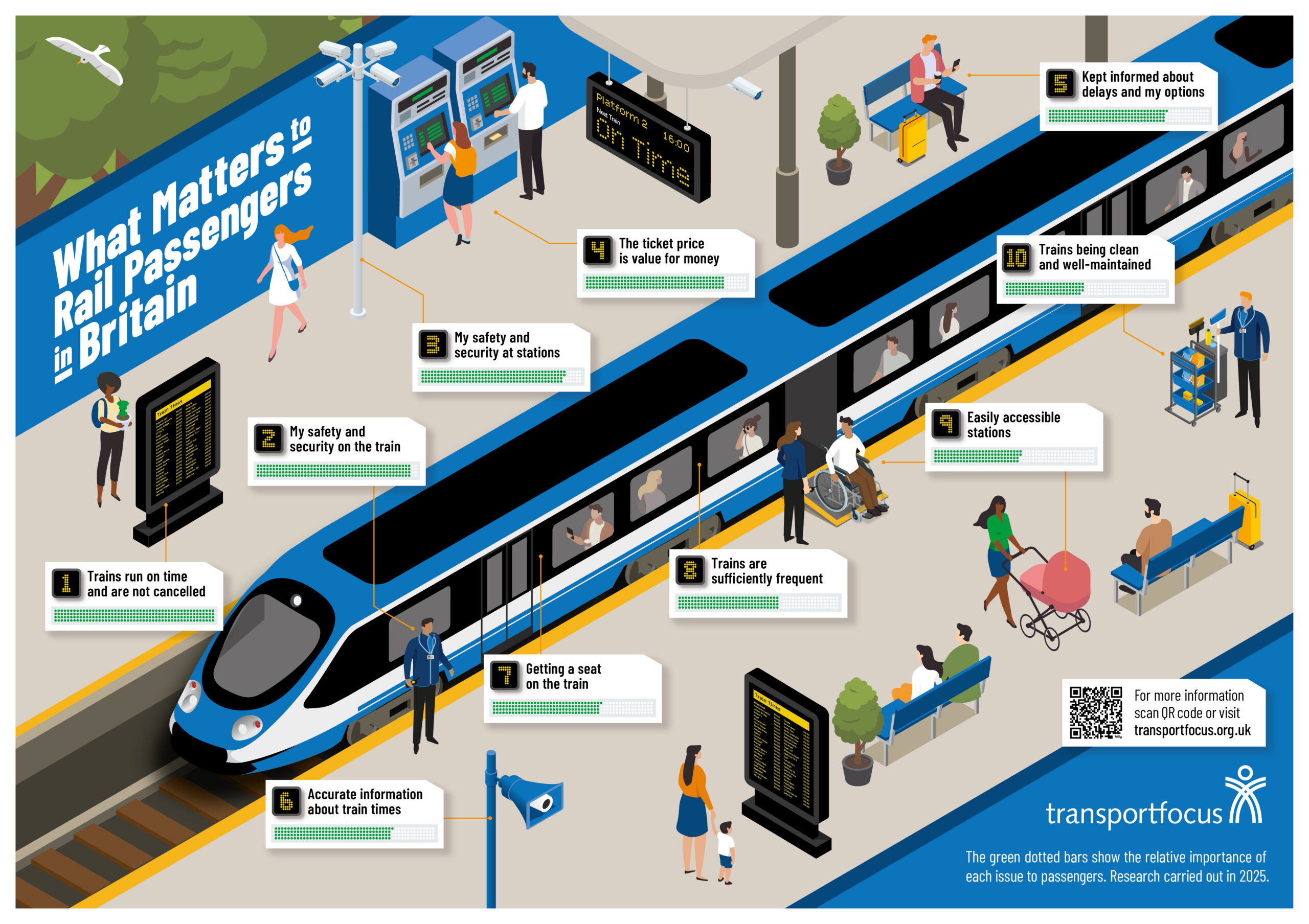
Passengers reiterated the importance of the basics: that running trains on time and not cancelling them really matters, alongside value for money (a mix of price, punctuality and reliability, comfort of the journey) and passenger information, including when something has gone wrong. And for some, including disabled passengers, that focus on basics extends to things like lift maintenance and delivery of passenger assistance. Delivering the basics matters not just because late trains are frustrating, but because of the negative knock-on impacts on plans and confidence in the railway getting them where they want to be.
The railway must have a relentless focus on running trains on time and not cancelling them. The causes of delay and cancellations must be identified and systematically tackled, including forensic analysis of where the timetable works in theory but imperfectly in practice. Basics in other areas also need focus, such as maintaining lifts and delivering Passenger Assist to a consistent high standard.
Passengers told us that personal safety and security matters. They put the issue – on trains and at stations respectively – in second and third place in their ‘what matters’ list. For women, disabled people and passengers in all ethnic groups except white, personal safety and security on trains was actually top of their ‘what matters’ list.
While the railway has not caused the concern passengers have about personal safety when travelling, it must own the problem and develop a comprehensive strategy to address it. The public realm the railway is responsible for must be managed in a way that passengers both are safe and feel safe. We look forward to discussing initiatives in this area with the rail industry and others such as the British Transport Police.
We know that the findings are already being used to put passengers at the heart of planning Funding Period 1 (2029-2034), and we expect them to inform GBR’s Integrated Business Plan, its customer strategy and accessibility strategy – as well those in Scotland, Wales and elsewhere that rail services are devolved. We expect that the findings will inform the UK Government’s Long-Term Rail Strategy – which will set the railway’s strategic objectives over a 30-year horizon – and delivery of the National Transport Strategy in Scotland and the National Transport Delivery Plan in Wales.
So what happens next? Transport Focus has used these findings to inform the priorities set out in our forthcoming commentary on the first six months’ data from the new Rail Customer Experience Survey. This will be published on 18 June. We’ll also use them to test whether the key policies and strategies produced by governments and the railway – both before and after GBR is established, locally and network-wide – align with what matters to passengers.